based on 5000+ sales. Wholesale discount applied automatically any 10+ pcs

When to order Event patches in Europe: the 3-week ordering window
The comfortable window for ordering custom event patches in Europe is about three weeks before the event. In those three weeks a 50–100 piece order can move cleanly through digital preview and approval, an optional physical sample, production, and delivery inside the EU – all without rushing a single step or paying for speed you didn’t plan for. Order earlier and you have slack; order inside a week and the timeline starts making decisions for you and cost more.
Here’s how the window actually works, and how to find the latest day you can safely place your order.
What has to happen between your order and your event
Four things sit between “we’d like patches” and “the box is at the booth”:
- Digital preview and your approval. We turn your logo into a production-ready preview so you can see stitch layout, size, colours and backing before anything is made. Nothing goes into production until you approve it.
- A physical sample (optional). For a first order, or a design with fine detail, many teams want one stitched piece in hand to evaluate before committing the full run. This is a preview step, not a formality – it’s where small corrections get caught cheaply.
- Production. Once approved, a 50–100 piece batch is a few working days on the machine, depending on size and stitch coverage.
- EU delivery. From Finland to most EU destinations is a courier delivery – typically 4-6 working days, with no customs step along the way.
Why three weeks is the comfortable window
A realistic shape for a 50–100 piece first order:
- Order placed, payment received, preview prepared and sent: 2–4 working days (plus however long you take to approve)
- Physical sample, your approval online: roughly adds 2–3 days
- Production of the full batch: 3-6 working days
- EU delivery to you: 4–6 working days
That adds up to three weeks, which is the point — the window is built to absorb a weekend, an approval, or one round of changes without touching your event date.
What a last-minute order actually costs
Short lead times don’t just raise stress — they remove options:
- Rush production reorders the production queue, and that premium is real work, not a markup for its own sake, often a weekend overtime, expect rush-order pricing
- Express courier replaces standard EU shipping, often for a few days you could have had for free with earlier planning.
- No sample safety net. Inside a week there’s no time to approve a physical piece, so the digital preview becomes the only checkpoint. That’s workable, but it’s less forgiving.
- Compressed approvals. When there’s no slack, one unanswered email on your side can cost the whole buffer.
- Fewer finishing choices. Some backings and finishes need a little more time; a tight deadline quietly narrows what’s available.
None of this makes a last-minute order impossible — we do them. It just makes them cost more and flex less, for reasons that are production reality rather than policy.
How to work out your latest safe order day
Count backwards from the event:
- Event date, minus 2 working days as an arrival buffer (parcels should land before you travel, not during)
- minus 4–6 working days EU delivery
- minus production time (3-6 working days for 50–100 pcs)
- minus order placement and approval time — the payment, the preview and, if you want one, the sample
Worked example: a 60-piece order for a Thursday event, shipping to Germany. Arrive by Tuesday → ship Wednesday the week before → approve and produce one week starting from previous Wednesday → place the order, with preview, about 12–15 working days out. Three calendar weeks gives you that, plus small room for some change.
If your date is tighter than that, tell us the event date first. We’ll tell you honestly what the window allows before you commit.
What moves the timeline up or down
- Quantity. 50 and 100 pieces sit in a similar window; a few hundred needs more runway.
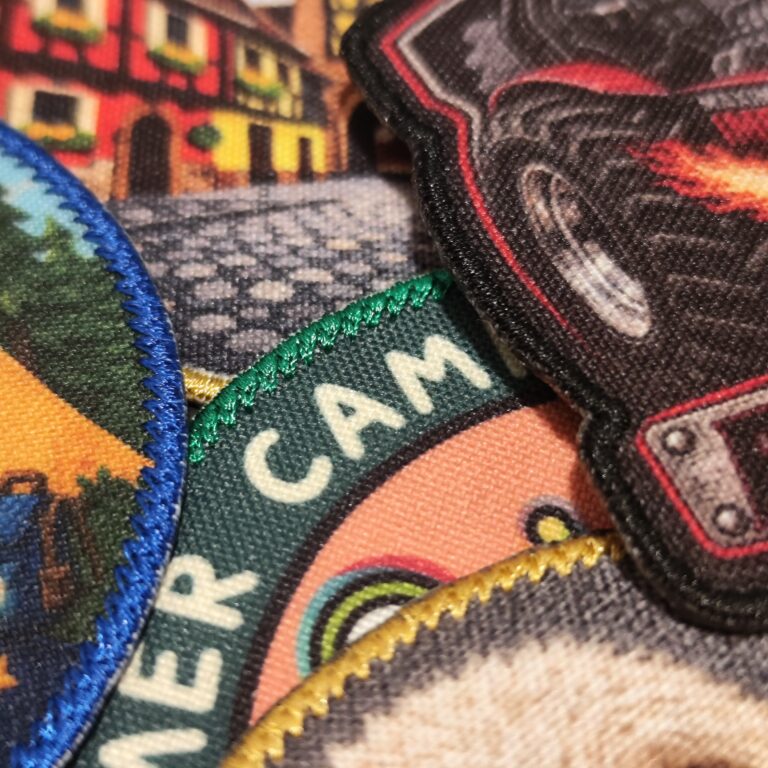
- Design route. A full embroidered patch and a print-on-textile patch (print with an embroidered border) run on different timelines: print-on-textile is always faster than a dense embroidery.
- Backing. Iron-on, sew-on, and hook-and-loop patches differ slightly in finishing time. Hook and loop adds one more machine operations, thus takes more time.
- First order vs reorder. The first order includes a one-time digitising step; reorders of the same design skip it and move faster.
- Destination. Within the Central EU mainland it’s days. There’s no customs clearance to wait on, which is a large part of why the window stays predictable.
For 50–100 pieces, about three weeks from order to delivery is comfortable: preview and approval, an optional sample, a few days of production, and 4–6 working days of EU delivery. Faster is possible but reduces your margin for changes.
Often yes, as a rush order, and usually print-on-textile version. There is still expedited production and express courier cost and time.
No fixed minimum — but event orders are usually most sensible from around 50 pieces, where unit economics and the digitising step balance out.
Printed patch with embroidered border is quick either way. A detailed, full-colour or gradient logo is usually faster and cleaner as print-on-textile (print with an embroidered border) than as heavy embroidery.
No. Digitising is a one-time step on the first order of this specific design. Reorders of the same patch skip it entirely.
Have an event date in mind? Send us the date, your logo and a rough quantity to get a non-binding quote before you commit anything. We’ll confirm your latest safe order day in the same message.